The Heat Is On: What a Hot Shed Does to Your Herd
Adult dairy and beef cattle feel heat stress in the shed long before the forecast makes the news. This is about cows and finishing cattle, not calf-pen pneumonia.
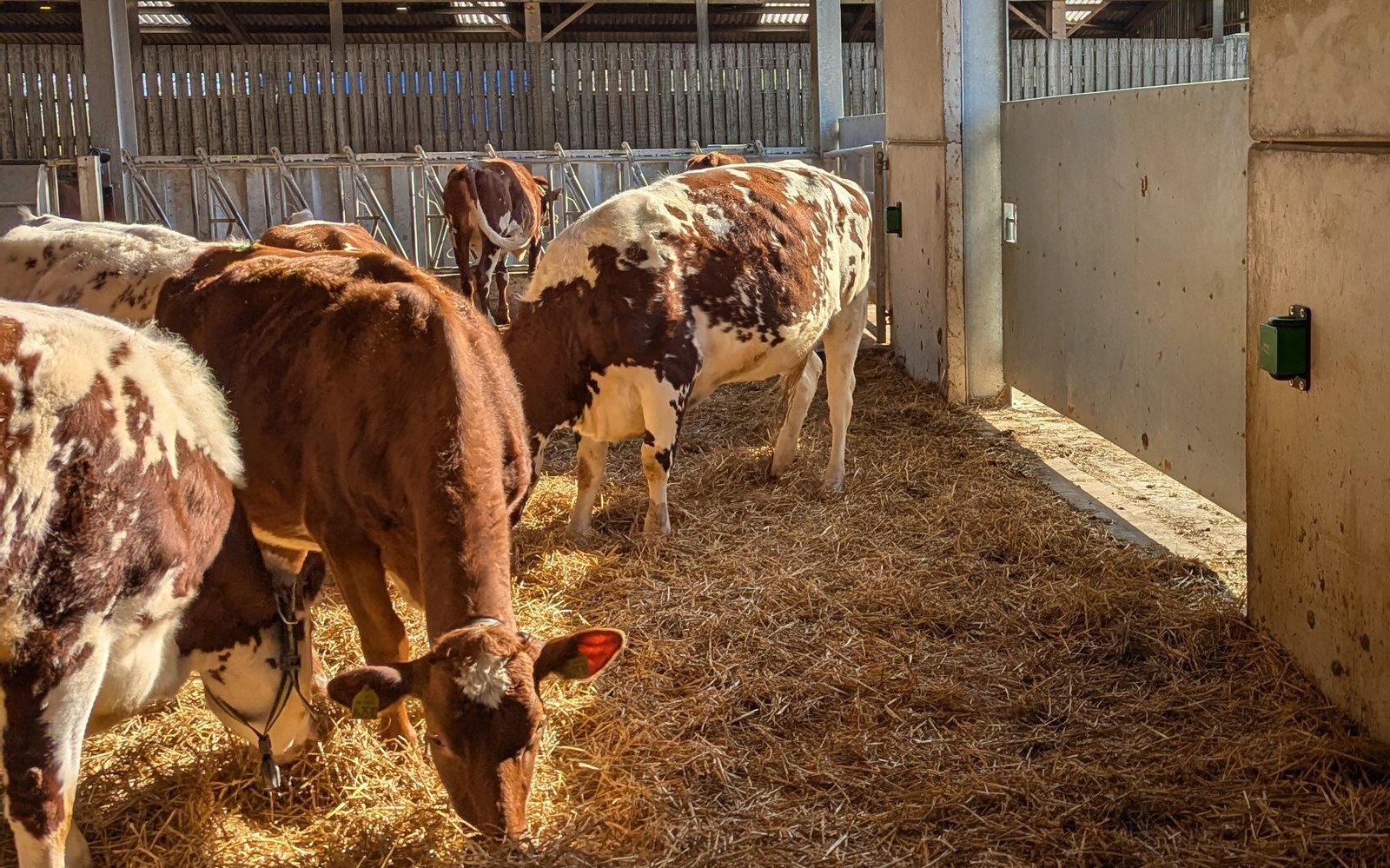
Adult cattle use case. This article is about heat stress in milking cows and finishing cattle. It is separate from Pneumonitor’s calf-pen pneumonia monitoring. Same idea — measure the air the animals actually live in — different animals, different risk, different decisions.
On 25 May 2026, the UK hit 34.8°C, the hottest May day ever recorded. It’s not even summer. And the animals standing in the shed felt it long before the forecast made the news. In adult cattle housing, in-shed monitors recorded THI values over 78.
By the time you can see heat stress, you’ve already paid for it. The expensive damage is quiet, it’s gradual, and it happens in the air your animals are actually breathing and standing in, not the air outside the door. So let’s talk about what the heat is doing to the cow in front of you and what it’s costing on the farm.
The Cow
A dairy cow is comfortable from around −10°C up to about 20°C. A high-yielding cow is a furnace: all that feed and milk generates so much internal heat that the best cows can start to struggle in a well-ventilated shed at air temperatures as low as 18°C.[2] Your top performers are the first to suffer.
Two things make it bite harder than the thermometer suggests:
Damp air. Panting and sweating only cool a cow if the moisture can evaporate. On a muggy UK day, humidity in housing routinely above 80%, near 100% in a stuffy shed. that cooling fails exactly when she needs it.[3]
Warm nights. Cattle bank heat through the day and offload it overnight. A run of close, sticky nights gives them no chance to recover, and the heat load piles up.[4] A week of warm nights does more damage than one hot afternoon.
The number your animals are feeling: THI
The thermometer alone won’t tell you if the herd is in trouble. Heat plus humidity does, combined into one figure, the Temperature–Humidity Index (THI). It’s the most useful way to read a shed for heat stress.
There are debates around the exact threshold but everyone agrees that high heat stress isn’t ideal. Losses begin to show from around THI 68.[5]
| THI | What it means for the herd |
|---|---|
| Under 68 | Comfortable |
| 68–71 | Intake starts to dip, losses begin |
| 72–79 | Clear drop in milk and feeding |
| 80–89 | Severe, production tanks, welfare at risk |
| 90+ | Emergency |
And roughly where that lands in real conditions:
| Air temp | Dry (RH 50%) | Muggy (RH 90%) |
|---|---|---|
| 22°C | 68 | 71 |
| 25°C | 72 | 76 |
| 28°C | 76 | 81 |
| 30°C | 78 | 85 |
| 32°C | 81 | 88 |
Look at 22°C — an ordinary UK afternoon. On a humid day that’s already mild stress. You don’t need a heatwave to lose milk; you need a warm, damp shed.
What it actually costs you
AHDB puts it simply: for every point of THI above 69, a cow loses about 0.4 kg of milk a day, and daily yield falls by roughly 20% as conditions go from spring-cool to summer-hot.[1]
Run that on a real herd. Say THI sits at 75 for a three-week hot spell. That’s six points over the line, so about 2.4 kg per cow per day, or near enough 50 kg of milk lost per cow across the spell. On 150 cows that’s around 7,500 litres gone, before you’ve counted a vet bill.
And the milk in the tank isn’t the only hit. Somatic cell counts reliably peak in August and September, and housed herds see more summer mastitis, enough, on some farms, to tip a milk-price band.[6]
Beef feels it too
Finishing cattle run hot off high-energy rations and can’t shed it fast enough on a close day, intake stalls and daily gain stops, and pneumonia diagnoses tend to climb a couple of days after a heat spike.[7] Dark-hided and near-finished animals are most at risk.[7] But beef responds fast to simple help: in one trial, cattle given shade and cooling water gained 18% quicker and converted feed 12% better than those without.[8]
Your shed is hotter than you think
Here’s what most heat-stress advice misses. The forecast gives you the temperature outside, in the shade. Your animals don’t live there.
A well-stocked building can sit up to 10°C warmer than outside, with humidity far higher.[3] A thermometer by the door tells you almost nothing about the THI in the back of the shed, where the herd is actually breathing. You can be comfortable in the yard while cows fifty feet away are well into moderate stress, and have no way of knowing until the tank tells you a week later.
Some fixes
This is the good news: cooling cattle is one of the best returns on the farm, and most of it is cheap. Roughly easiest first:
- Water first, always. Demand rockets in heat, make sure trough space and flow keep up, keep them clean, add extra portable points so there’s no queueing or being bullied off the trough.[9]
- Move the air. Dead, stale air traps heat and humidity. Open the sides, clear what’s blocking natural flow, run fans or tube ventilation where you can.[3] Moving air pulls heat straight off the skin.
- Spread them out. Fewer bodies in the same air means less heat and humidity. Overcrowded sheds run hotter, drop stocking density where possible through a hot spell.[10]
- Mind the pinch points and the clock. Collecting yards are heat traps, cooling and airflow there pay off fast.[3] Handle, move and feed in the cool of early morning or evening, and don’t shift stock when THI is high.[9]
Where Pneumonitor fits
That’s what Pneumonitor does. It’s a rugged sensor that lives inside the pen, breathing the same air the animals breathe, reading the real temperature and humidity at animal height, instead of what a thermometer on the wall claims. It works the number out in real time and tells you before stress turns into lost milk. Diagnose the pen, not the wall.
Sources
- AHDB — Assessment of heat stress in dairy cows. https://ahdb.org.uk/assessment-of-heat-stress-in-dairy-cows
- University of Minnesota Extension — Heat stress in dairy cattle. https://extension.umn.edu/dairy-milking-cows/heat-stress-dairy-cattle
- NADIS — Managing Heat Stress in Dairy Cows. https://www.nadis.org.uk/disease-a-z/cattle/managing-heat-stress-in-dairy-cows/
- Ohio State University — Heat Stress in Feedlot Cattle (night-time recovery). https://u.osu.edu/beef/2018/07/11/heat-stress-in-feedlot-cattle/
- Journal of Dairy Science / PMC (2025) — milk-loss threshold near THI 68 (Zimbelman et al., 2009). https://pmc.ncbi.nlm.nih.gov/articles/PMC12598488/
- Phibro Europe — Is heat stress in UK dairy cows more about health and welfare than production? https://europe.pahc.com/blog/is-heat-stress-in-uk-dairy-cows-more-about-health-and-welfare-than-production
- K-State — feedlot heat stress; pneumonia (BRD) rises ~2 days after a temperature spike. https://krex.k-state.edu/items/51aa531d-2a15-42db-9b45-2d09621b4122
- PMC (2025) — feedlot heat-stress mitigation (ADG +18%, FCR +12%). https://www.ncbi.nlm.nih.gov/pmc/articles/PMC11868087/
- PubMed — Managing Heat Stress Episodes in Confined Cattle. https://pubmed.ncbi.nlm.nih.gov/29935720/
- Illinois Extension (2025) — Prevention and signs of heat stress in cattle. https://extension.illinois.edu/blogs/cattle-connection/2025-06-24-prevention-and-signs-heat-stress-cattle
This article is about adult cattle heat stress in housing. Pneumonitor’s primary product focus is calf-pen environment monitoring for pneumonia risk. General information only. Milk-loss figures are illustrative.